
“You’re So Sensitive.” (Why Sensitivity Is a Strength-Especially Right Now.)
Written by Dr. Colleen Reichmann. Founder and clinical director of Wildflower Therapy.

“You’re so sensitive.”
For many people, that sentence is packed with years of pain. It lands like a dismissal. A tone-policed shutdown. A subtle message that your perceptions, emotions, or pain are too much, and therefore untrustworthy.
But what if sensitivity isn’t a flaw at all?
What if sensitivity is a biological trait, a psychological strength, and an adaptive response to a world that often rewards numbness over noticing?
As a therapist in Philadelphia who works with folks struggling with eating disorders, OCD, anxiety, depression, trauma, and more-I see a lot of highly sensitive kids, teens, and adults throughout my week. And I see this pattern constantly: deeply perceptive people who learned very early that their sensitivity made others uncomfortable (or even angry). So they adapted. They quieted. They disconnected and discovered ways to cope that were creative and available to them.
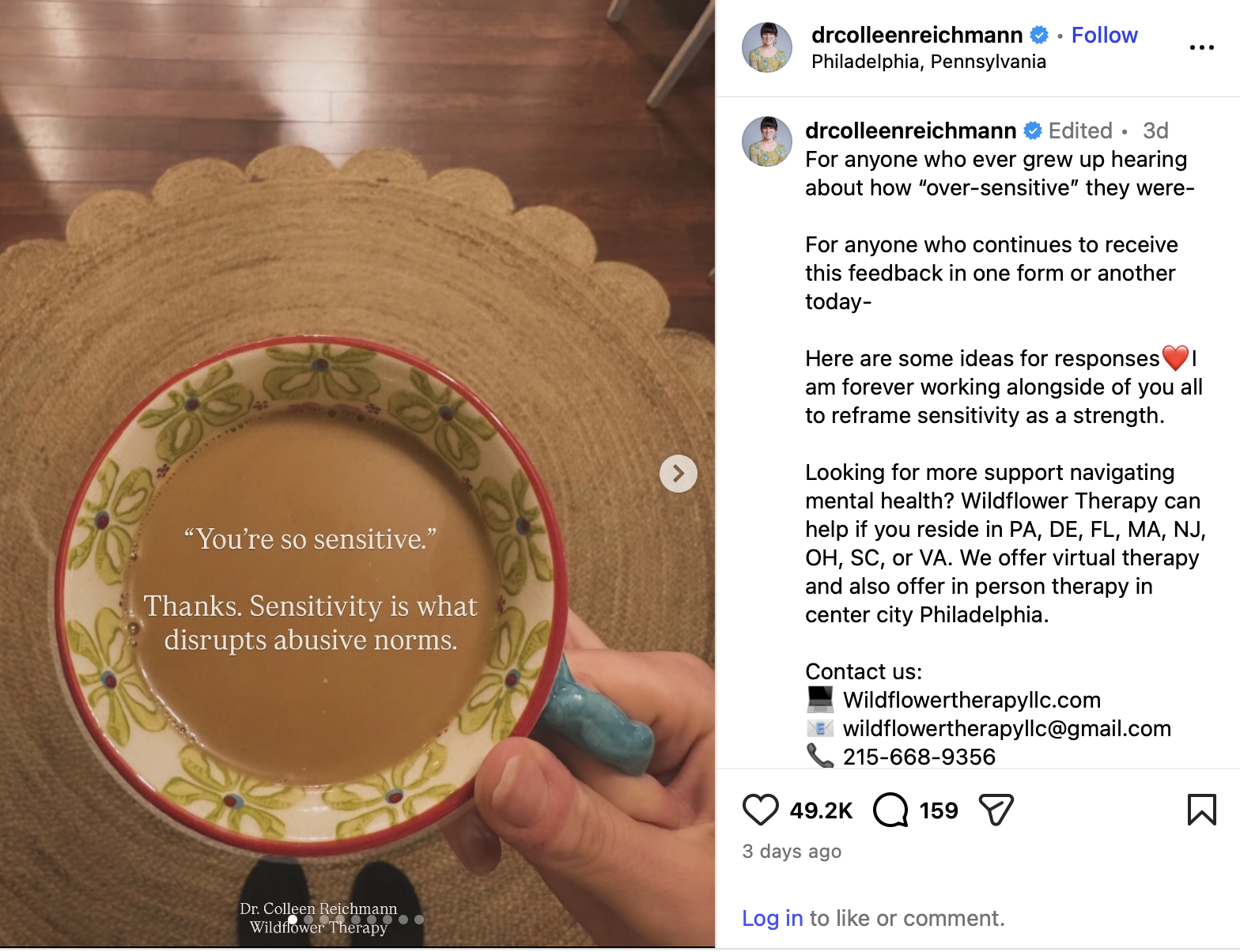
I recently posted a carousel of responses to “You’re so sensitive” on my professional social media (see pic below) and was surprised when the post quickly went viral. The comments flooded in thanking me for framing sensitivty in a positive light, and so I felt inspired to write a longer form post.
This is my invitation to reconsider sensitivity not as something to “toughen up from,” but as something worth protecting.
Sensitivity Is a Real, Measurable Trait (Not a Character Flaw)
Sensitivity isn’t just a personality quirk or an insult people throw around when emotions get inconvenient. There is a body of research that has been compiled over DECADES showing that some people have nervous systems that genuinely process the world more deeply.
Research on Sensory Processing Sensitivity (SPS) (often associated with the term Highly Sensitive Person (HSP)) shows that sensitive individuals tend to:
Process sensory and emotional information more deeply
Have heightened awareness of subtleties and patterns
Experience stronger emotional and physiological responses to both pain and pleasure (aka they do actually feel pain more strongly and are not, in fact, “overreacting”)
Show increased activation in brain regions related to empathy, meaning-making, and reflection
In other words: sensitive brains take in more data and spend more time integrating it.
This obviously isn’t weakness when we look at it via the research lens, right? It’s a different (and very advantageous) operating system.
From an evolutionary perspective, sensitivity likely played (and still plays) a critical role. Groups need people who can detect shifts in mood, danger, injustice, or relational rupture early. People who notice what others gloss over. People who feel the cost of harm before it becomes catastrophic. People who have strong pattern recognition. Sensitivity has always been adaptive.
Sensitive People Feel Pain Differently, and That Matters
Highly sensitive nervous systems don’t just process emotions more deeply; they often experience physical and emotional pain more intensely as well. Brain imaging studies show differences in pain perception, emotional reactivity, and stress response.
So when a sensitive person says, “That really hurt,” they are being factual, not dramatic. Their brains literally show a higher degree of response to pain. So maybe we….believe them instead of trying to gaslight them into thinking that this is all in their head? I don’t know. Just a crazy idea from your friendly neighborhood psychologist and fellow HSP!
Because really, the problem isn’t the sensitivity. It’s not that it’s an issue that our brains respond with more heightened reactions. The problem is living in a culture that responds to pain with minimization instead of care.
When sensitivity is met with invalidation, people don’t become less sensitive. They become less connected to their sensitivity.
“You’re Too Sensitive”: A Common Thread in Childhood Trauma
Many adults I work with—especially those with eating disorders, chronic dissociation, or complex trauma-can trace their coping patterns back to repeated experiences of being told:
“You’re overreacting.”
“You’re too emotional.”
“You need to toughen up.”
“That didn’t hurt that much.”
Often these messages came from caregivers, authority figures, or (statistically more often) male partners who framed emotional expression as irrational, inconvenient, or excessive.
Over time, the lesson becomes internalized:
My perceptions aren’t safe. My feelings are a problem.
And so the nervous system adapts. Some people learn to numb through dissociation, while others learn to control their bodies through food, restriction, or binge-purge cycles. Some learn to intellectualize, perform competence, or stay relentlessly “high-functioning.”
Eating disorders, in particular, often function as a regulation strategy for sensitive people. They become a way to mute sensation, emotion, hunger, grief, anger, or need.
Again, none of these strategies come to be because of weakness. They come to be because the individual was never taught how to be sensitive without being shamed for it.

Numbness Is Not Healing. It’s a Survival Strategy
In therapy (especially trauma-informed therapy)-we’re often not helping people “become more emotional.” We’re helping them reconnect with emotions they learned to shut down to survive.
Numbness can look like strength in a culture that values productivity over presence. But numbness comes at a cost: disconnection from joy, creativity, meaning, and embodied intuition. Sensitivity is what allows people to feel grief and hope. Rage and tenderness. Fear and moral clarity.
And in times like these-politically, socially, environmentally- we desperately need people who can still feel. We need people to notice what’s happening, weep about the injustice, experience their rage-and rush into calls to action.
We Need Sensitive People to Notice, Name, and Push Back
Sensitive people are often the first to notice when something is wrong. They feel injustice in their bodies before it becomes headline news, and then register relational harm before it turns into abuse. They grieve losses others rush past.
In this way, sensitivity fuels:
Advocacy
Creativity
Attunement
Resistance to dehumanization
In a world that rewards dissociation and calls it resilience, sensitivity is a form of rebellion.
We need people who can yell and weep.
Who refuse to normalize cruelty.
Who stay awake to pain without becoming consumed by it.
Sensitivity doesn’t make you fragile. It makes you responsive.
Therapy for Sensitive Children, Teens, and Adults in Philadelphia & the Main Line
If you were labeled “too sensitive” growing up-or learned to cope by numbing, restricting, or disconnecting- you are not broken. Your nervous system adapted to an environment that didn’t know how to hold you. Therapy can help. And if you are noticing sensitivity as a trait that your child or teen is coping with, please know that therapy can help them too.
Therapy can help you:
Understand your sensitivity as a strength, not a liability
Work with (not against) your nervous system
Heal from trauma tied to chronic invalidation
Recover from eating disorders or disordered eating rooted in emotional suppression
Learn regulation skills that don’t require self-erasure
At Wildflower Therapy, we specialize in trauma-informed therapy, eating disorder treatment, and work with highly sensitive children, teens, and adults in Philadelphia and the Main Line area. Our approach honors depth, complexity, and the wisdom of the body, without asking you to become less of who you are.
Our therapists also support children, teens, adults, and families who are navigating things like ADHD, body image concerns, anxiety, depression, OCD, and maternal mental health/infertility.
We provide therapy in Philadelphia (and virtually for anyone in Pennsylvania, New Jersey, Delaware, Florida, South Carolina, Vermont, Virginia, Ohio, and Massechusetts.) We work with children, teens,, and adults. We are neurodivergent-affirming, queer-celebratory, and feminist-relational in our work.
We invite you to reach out for your free consultation call.

You’re Not “Too Sensitive.” You’re Paying Attention.
Sensitivity helps disrupt abusive norms.
Sensitivity tells the truth early.
Sensitivity keeps humanity intact when numbness is easier.
You don’t need to harden. You need support. And you deserve it.
Oh and PS- Abolish ICE. Prosecute all involved in the Epstein files. Impeach him. Yes. Saying this aloud is all part of being an ethical therapy practice right now. If you don’t know, now you know.